

The world is overly fixated on interest rates because so many have borrowed so much. Central banks have begun lowering interest rates, not because inflation has been tamed, but because lower rates are required to service the debts of many people, businesses, and governments. While interest rates are higher than a decade ago, they are moderate by historical standards. Bond feels that interest rates may moderate to some degree. However, it will not be to the degree many will need. Higher interest rates will increase the discount rate at which many assets are valued reducing their value at the expense of equity returns. At this part of the economic, fiscal, and monetary cycle, private credit is poised to offer superior risk-adjusted returns.
Rates Are Not High by Historical Standards
Canadian Interest Rate History

Source: WOWA, Bond Capital
While younger generations may feel current interest rates are historically high, the chart above shows that a historical high of 20.78% for the Bank of Canada overnight rate occurred in July 1981. After the Great Financial Crisis of 2008-2009, the Bank of Canada brought the overnight rate to a historical low of 0.25%. The overnight rate then averaged 0.86% while it increased gradually to 1.75% over the next decade, only to drop back to a low of 0.25% at the onset of the Bank’s reaction to the Covid-19 crisis in early 2020. These historically extraordinary low rates resulted in an “everything bubble”. Beginning in the spring of 2022 to combat inflation of their own making, central banks increased rates rapidly. This unadvertised and very rapid action created significant pressure for over-leveraged, cash-poor companies and households who are now seeking rate reductions. Substantive relief appears unlikely to arrive as a glance at the chart above illustrates that the recent 5% crest and current overnight rate of 4.25% are not overly elevated. We say this because since inception, the BoC average overnight rate is 5.27% and the median is 4.5%.
The bond market is losing its economic predictive ability due to central bank intervention. The Fed is now the largest individual holder of US government debt, and at any given time often the largest buyer and or seller of T-bills. Furthermore, the U.S. has over 120% federal debt-to-GDP compared to ~30% in the 1980’s and 2000’s. Predicting the future is a mugs game and central banks fall victim to losing sight of this. What could go wrong if the institution that sets short-term interest rates and buys and sells longer-duration Treasury securities in large volumes regularly lacks the ability to forecast accurately?
We expect inflation to moderate. Barring large geopolitical incidents, interest rates will remain constructive and decrease, just not to the historically artificially low levels of the last 15 years. Until we face the next severe economic crisis, the Bank of Canada overnight rate will level off between 2.5% to 3.5% to keep within 100bps of the Fed (the current spread is 108bps). Higher interest than “hoped for” leads us to believe that access to capital will be a more prevalent concern than the cost of capital.
Private Credit Poised to Outperform
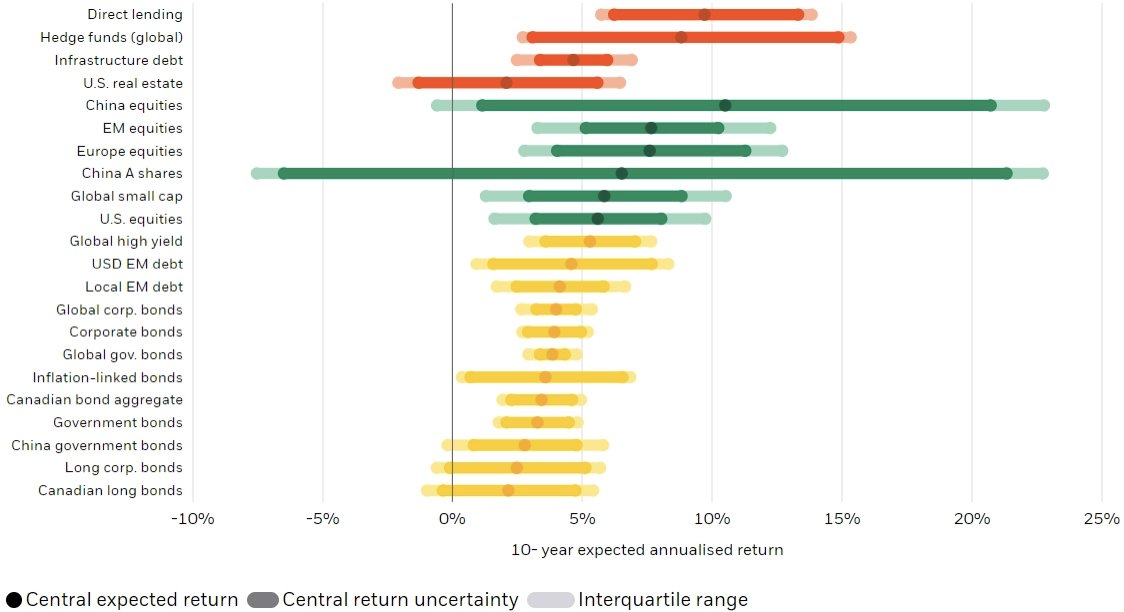
Asset Return Expectations and Uncertainty (CAD)
Source: Blackrock
Each asset class reacts to interest rates differently, so it is important to be diversified. Investors can benefit from private credit’s ability to garner a contracted heightened interest rate that floats (in case rates rise) and is mitigated by downside protection (in case rates fall). As indicated in the chart above, private credit is expected to outperform the majority of asset classes, with less volatility, and based on their asset allocation decisions, numerous institutional investors agree.
About Bond Capital
Bond Capital is an award-winning private credit fund. As a direct lender, Bond Capital provides advice and money across the entire risk curve. Bond Capital secured structured credit financing enables business owners to maintain control ownership in exchange for yield and capital preservation. Across multiple cycles and for over 20 years, Bond Capital has advanced secured investment quality credit to lower middle market companies throughout North America.


