

Simplifying the Capital Structure
When a private equity firm acquires a mid-sized business, the financing question is rarely simple. Traditional bank loans cap out at conservative leverage levels. Along with extra leverage, a mezzanine debt facility adds a second lender, a second credit agreement, a second set of covenants, and weeks of additional negotiation on the inter-creditor agreement. That leads to delays, and time can be a deal killer. Enter the unitranche loan. To the borrower, a unitranche looks and feels like a single, first-lien term loan from one lender: one credit agreement, one covenant package, one closing. For operators financing a transaction, the structure determines speed, cost, and flexibility. As bank lending standards continue to tighten, knowing how unitranche loans work has never been more practically valuable.
What Is a Unitranche Loan?
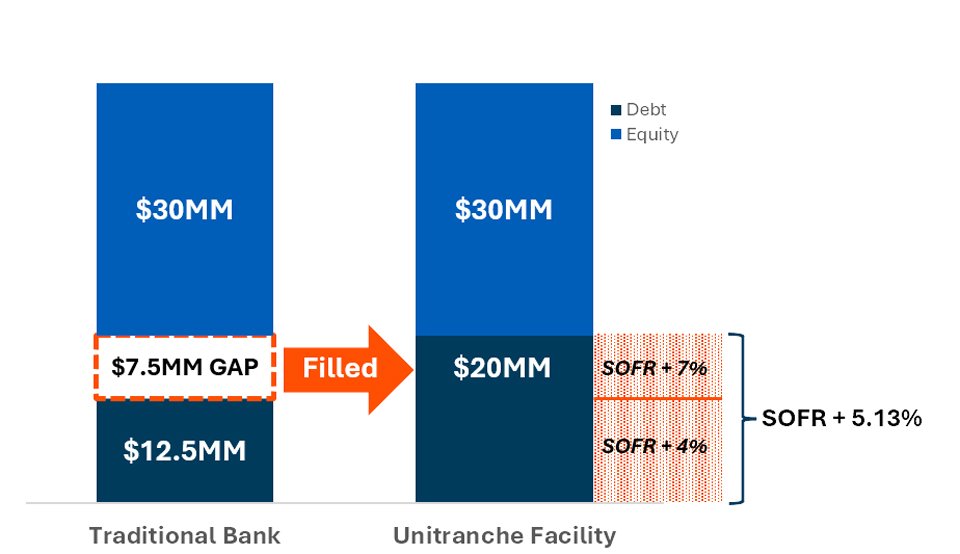
A unitranche facility is a single-tranche term loan that blends senior and subordinated debt into one instrument, governed by one credit agreement, with one set of collateral documents granting liens for the benefit of all lenders in the facility. Behind the scenes, however, the loan is often split between two lending parties. In first, a bank or conservative credit fund taking the First-Out position and in second, a private credit fund absorbing the riskier Last-Out piece. This is often governed by a confidential Agreement Among Lenders (AAL) that the borrower typically never sees. The structure offers borrowers a streamlined, one-stop facility that is faster, more certain in execution, and potentially more cost-effective than a traditional bifurcated debt stack.
The key innovation is what happens between lenders. In a traditional first-lien / second-lien structure, each lender group has its own loan agreement and the relationship between them is governed by an intercreditor agreement. In a unitranche, all lenders share a single lien. Their internal economics, including who gets paid first, who controls enforcement, and how payments are split in a default, are governed by the Agreement Among Lenders (AAL). Bond Capital can make this concept one step simpler when it prices a single lender unitranche loan and holds all of the risk.
Unitranche Facility Example
Source: Bond Capital
The AAL synthetically separates lenders into a First-Out tranche and a Last-Out tranche, effectively mimicking the senior/junior lien structure while maintaining a single credit agreement with the borrower. According to Mayer Brown, the unitranche structure has several advantages, including typically quicker execution and, in some cases, a lower cost of capital to the borrower, as the blended rate smooths out what would otherwise be a more expensive subordinated tranche.
Current Market Relevance
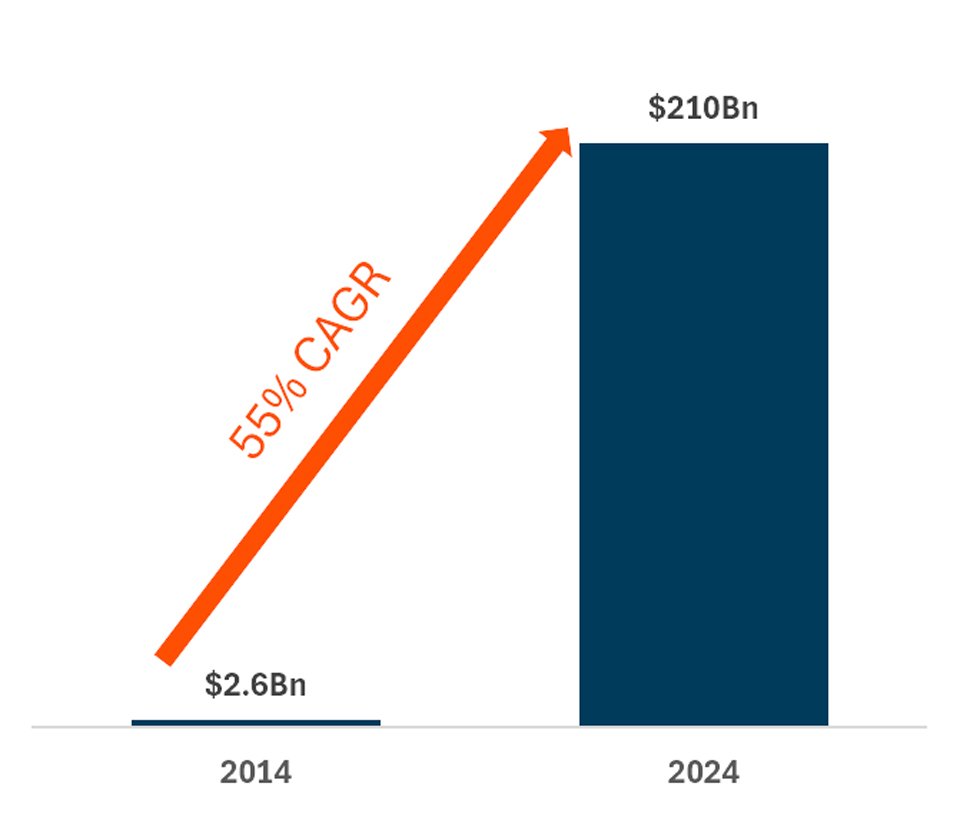
The unitranche market has expanded dramatically over the past decade-plus, from a relatively niche lower-middle-market product in 2014, with $2.6 billion in loan volume, to approximately $210 billion in 2024, with the product expanding well beyond its traditional $50–150 million facility size into transactions of $500 million and above. For lower-middle-market borrowers, pricing in Q2 2026 sits at approximately SOFR + 425-750 basis points, with 3-month Term SOFR at roughly 3.73%.
Unitranche Deal Volume Growth
Source: Bond Capital; Baker Donelson
That backdrop matters because banks are still tightening. The Federal Reserve’s April 2026 Senior Loan Officer Opinion Survey (SLOOS) reported that banks tightened lending standards and all surveyed terms for Commercial & Industrial loans to firms of all sizes in Q1 2026, with the most widely cited changes including higher premiums on riskier loans, stricter loan covenants, and lower maximum credit line sizes.
This sustained tightening cycle, now running through multiple consecutive SLOOS surveys, is the structural tailwind redirecting middle-market borrowers toward private credit lenders offering unitranche facilities.
The scale of that redirection is measurable. According to PIMCO, total AUM in North American direct lending portfolios increased roughly sevenfold over the past decade, from $93 billion in 2015 to approximately $644 billion by year-end 2025. According to McKinsey, the seven largest private credit platforms grew AUM at approximately 20% annually from 2022 to 2025, and private credit now funds over 80% of all LBO transactions.
On the lender side, Valuation Research Corporation (Q2 2026) reports that unitranche yields remained broadly stable on a spot basis in Q2 2026, with credit spreads largely unchanged. Wider spreads, higher-for-longer rates, and bank retrenchment are improving pricing and terms for disciplined lenders, with the current environment favoring lenders with strong underwriting and a durable cash flow focus.
For Investors Evaluating Private Credit Funds
- Ask whether the fund holds First-Out or Last-Out positions. Last-Out holders absorb losses first in a default and may receive PIK rather than cash interest in distress. The higher spread they earn compensates for this subordination, but recovery rates will diverge sharply in a downturn.
- Scrutinize the AAL terms. Not all AALs are equal. Investors evaluating a direct lending fund should consider how the fund’s AALs define control rights during enforcement, who can block amendments, and what the voting thresholds are for restructuring scenarios.
- Assess covenant quality. McKinsey data shows covenant-lite direct lending transactions rose to 21% of deals in 2025, up from just 4% in 2023. Covenant-lite loans reduce early warning signals for lenders. Investors may consider evaluating whether a fund’s portfolio is concentrated in cov-lite structures and whether that reflects competitive pressure rather than deliberate underwriting.
- Consider concentration risk. Unitranche deals often involve one to three lenders. Lender- concentration risk, where a shift in a fund’s strategy or capacity can affect a borrower’s refinancing options, is a distinct consideration versus broadly syndicated credits.
For Operators Evaluating Unitranche Financing
- Speed is a genuine advantage. Private credit lenders offering unitranche facilities can typically close within approximately four to eight weeks with well-prepared borrowers, while bank-syndicated deals may require ten to twelve weeks, according to empirical evidence and Bond Capital.
- Price the all-in cost carefully. Headline spread is only part of the picture. Original issue discount (OID), amendment fees, and prepayment premiums over the loan life can materially increase the effective cost of capital above the quoted SOFR + spread.
- Evaluate lender flexibility post-close. Because unitranche lenders typically hold loans to maturity rather than selling into secondary markets, the relationship dynamic matters. A lender who knows your business and holds a concentrated position has both the incentive and the capability to work constructively through covenant breaches or business volatility.
Key Takeaways
- One loan, two risk positions: A unitranche loan appears as a single first-lien facility to the borrower, which it can be in a single lender structure. In the alternative multi-lender structure, the AAL internally bifurcates it into First-Out (senior-equivalent) and Last-Out (junior-equivalent) tranches with distinct economics and control rights.
- Bank retrenchment is the structural driver: Consecutive Federal Reserve SLOOS surveys through Q1 2026 confirm tightening bank C&I lending standards. Compared to the U.S., Canada is a more conservative lending market, and Canadian lending standards have been modestly easing across 2026. In both markets, traditional bank lending is redirecting middle- market borrowers toward private credit unitranche lenders who can provide higher leverage in a single facility. A borrower that can often obtain 5.0x to 6.5x EBITDA in the U.S. may find Canadian lenders comfortable closer to 4.0x to 6.0x, depending on sector, sponsor quality, and cash-flow stability.
- Pricing carries real complexity: At SOFR + 425–750 bps for lower-middle-market transactions in Q2 2026, all-in costs exceed the headline rate once OID and fees are incorporated. Operators may find this cost justified by execution speed and structural flexibility.
- Covenant erosion is a risk to monitor: The rise of covenant-lite unitranche deals in the U.S. (from 4% to 21% of direct lending transactions between 2023 and 2025) reduces lender early-warning mechanisms. Investors may consider evaluating the trade-off between borrower-friendly terms and lender protection in any fund they assess.
- The AAL is the document that matters most in distress: In a distressed scenario, how the AAL allocates payments, remedies, and voting control will determine outcomes for each lender group. Understanding AAL mechanics is essential for any investor participating in, or operator financing through, a unitranche structure.
About Bond Capital
Bond Capital is an award-winning private credit fund. As a direct lender, Bond Capital provides advice and money across the entire risk curve. Bond Capital secured structured credit financing enables business owners to maintain control ownership in exchange for yield and capital preservation. Across multiple cycles and for over 20 years, Bond Capital has advanced secured investment quality credit to lower middle market companies throughout North America.


